Is KNX safe to buy? KnoxNet security analysis on Ethereum
Automated honeypot, tax, liquidity and contract-permission analysis of KNX on Ethereum. 0xf19304e6bfe0a18d2a0171758aa433921f192897
Last scanned:
CAUTION
9 signals · 90% data completeness
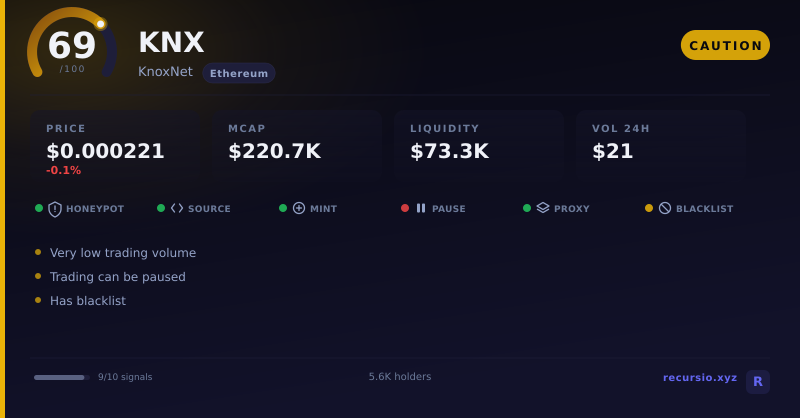
Recursio scores KNX 69/100 — the CAUTION band — from 9 signals at 90% data completeness. The score is held back mainly by Owner permissions (35/100), Market activity (20/100), Liquidity (50/100).
Taxes are 0.0% in and 5.0% out, so the price has to rise about 5.3% just to break even. Sell simulation succeeded for 2179 of 2180 real holder wallets.
$82.8K of liquidity across 1 pairs is enough for small trades, but a large sell will fill at a materially worse price.
The owner can still pause transfers, blacklist addresses, change the tax. That is not a prediction that they will — only that nothing stops them, and it happens without warning.
Key risks for KNX
- Sell tax 5.0%
- Owner can change the tax
- Owner can pause all transfers
- Addresses can be blacklisted
- Hidden owner
- Almost no 24h trading volume
KNX market & liquidity
| Price | $0.000209 |
|---|---|
| 24h change | 0.2% |
| Market cap | $209.4K |
| 24h volume | $49 |
| DEX liquidity | $82.8K |
| Holders | 5.6K |
| Trading pairs | 1 |
KNX contract security checks
| Honeypot | No |
|---|---|
| Verified source code | Yes |
| Mintable supply | No |
| Transfers pausable | Yes |
| Blacklist function | Yes |
| Proxy contract | No |
| Owner can change balances | No |
| Hidden owner | Yes |
| Ownership can be reclaimed | No |
| Self-destruct | No |
| Tax modifiable by owner | Yes |
| Trading cooldown | No |
| Cannot sell all | No |
| Buy tax | 0% |
| Sell tax | 5.0% |
| Owner holdings | 0.0% |
| Creator holdings | 0.0% |
| LP holders | 3 |
| LP locked | 99.9% |
Real-holder sell simulation for KNX
Recursio replays actual sell transactions for real KNX holders. This catches dynamic honeypots that pass a static contract audit — a token can look clean and still block most wallets from selling.
| Holders simulated | 2180 |
|---|---|
| Sold successfully | 2179 |
| Failed to sell | 1 |
| Fail rate | 0.0% |
| Simulated buy tax | 0.0% |
| Simulated sell tax | 5.0% |
| Highest tax seen | 50.0% |
| Risk level | low |
How the KNX safety score is calculated
The score is a weighted composite. Missing data lowers confidence rather than being silently skipped, and hard caps apply — a token with almost no liquidity or a failed sell simulation cannot score well no matter how clean its source code looks.
| Signal | Score | Weight |
|---|---|---|
| Honeypot risk | 85/100 | 22% |
| Contract security | 60/100 | 13% |
| Owner risk | 100/100 | 11% |
| Owner permissions | 35/100 | 11% |
| Holder distribution | 80/100 | 9% |
| Liquidity | 50/100 | 13% |
| Market activity | 20/100 | 9% |
| ERC-20 compliance | no data | 0% |
| Clone / fake token | 100/100 | 6% |
| LP safety | 100/100 | 6% |
Run a live KNX check
This page is a cached snapshot. Contract owners can change taxes, pause transfers or pull liquidity minutes later — always re-scan immediately before you trade.
Frequently asked
Is KNX a honeypot?
Automated checks did not flag KNX as a honeypot at the time of this scan, with a 0.0% fail rate across simulated real-holder sells.
What are the KNX buy and sell taxes?
Buy tax 0%, sell tax 5.0% when scanned. This contract lets the owner change the tax, so treat these numbers as a snapshot only.
Can I trust this score?
It aggregates GoPlus contract security, honeypot.is real-holder sell simulation and DexScreener market data into one number. It measures contract and liquidity risk — not whether a price will go up. Nothing here is investment advice.
How to check a token yourself · What is a honeypot token
Recently checked tokens
- crvUSD safety check (Ethereum) 10/100
- PYUSD safety check (Ethereum) 94/100
- WRAP safety check (Ethereum) 74/100
- USDtb safety check (Ethereum) 94/100
- OFC safety check (Base) 10/100
- UNKNOWN safety check (Base) 7/100
- Aurora safety check (Base) 10/100
- WAI safety check (BNB Chain) 10/100